Conference Papers (Abstracts)
Anglo-Chinese School (Independent)
Title
Abstract
Using crab shells to replace the calcium carbonate components of a microbial mat as it provides a buffer for the growth of the bacterial organisms. By then employing winogradsky tubes, the growth of the bacteria colonies can then be monitored and observed carefully. Our main interest was in the purple- coloured, anaerobic sulphurous bacterium which is able to remove lead from water.

Covent of the Holy Infant Jesus (Toa Payoh)
Title
Waste management and conservation of biodiversity in Singapore
Abstract
Singapore is a rapidly developing country with a land area of 699.4 sq km and a population of over four million people. In a short span of forty one years, Singapore has developed into a modern, technologically advanced and economically stable country. Rapid urbanization and population growth led to a greater need for waste management and conservation of biodiversity in Singapore. Over 7,700 tonnes are collected from household and industrial waste. To cope with the waste collected, there are four incineration plants built and two landfills Singapore. The fourth incineration plant, Tuas South Incineration Plant is built in the year 2000. Lorong Halus located on the main Singapore island has been filled up since 1999. The Pulau Semakau Landfill, located at the off shore islands of Singapore is expected to meet Singapore’s need for landfill space beyond the year 2045. As land is scarce in Singapore, reclamation of land is done to meet the needs of rapid urban development. However, reclamation of land has destroyed the vast biodiversity in Singapore, including some important mangrove and coral reef habitats. In this paper, we will examine how waste is managed and how the building of the Pulau Semakau landfill has impacted the biodiversity found and what can be done to conserve the natural biodiversity in Singapore in the midst of urbanization.
The High School Attached to Tsinghua University
As a widely used material, plastic is being produced, used and discarded massively. Massive waste plastic is considered to lead to “white pollution”, one of the most serious environmental problems in china. The purpose of this article is to find out the ultimate reason for “white pollution”. Plastic product and degradable material product are studied, the result indicates that using degradable material can’t reduce environment load, further analysis indicate the ultimate reason for white pollution is discarding waste plastic at discretion, using plastic has no fault.
The out line of this article is followed:
Present situation and resolvent of White Pollution
The waste plastic is littered around when finished using, because of main part is white colored, so called white pollution. White pollution disserves in two aspects: vision contamination and potential environment harm.
The two most popular resolvent of white pollution:
1 ceasing to use plastic
2 using degradable material to substitute plastic
The ultimate reason for white pollution
Based on the two points below, this article figures that white pollution is not produced by plastic, plastic is innocent.
1 Environmental load of plastic is lower than degradable material
Because of its advantages, plastic has been widely used in producing wrapper, wiring crust, container, medical instruments, etc. With plastic using, our life has been more convenient and comfortable.
The application of degradation materials is considered to be a good method to solve white pollution. However, using Life Cycle Assessment, published in ISO14040, to analyze plastic dishware and paper dishware, the result shows that plastic dishware has low environment load.
Part of result is listed as follows:
|
Life Cycle Assessment |
|||
|
Items |
Unit |
PS dishware |
Paper dishware |
|
Energy Consumption |
MJ |
194.48 |
673.995 |
|
Environment Load |
|
0.021362 |
0.479052 |
2 Discarding waste plastic at discretion is the ultimate reason for white pollution.
Vision contamination is because of discarding waste plastic at discretion. If people threw them into trash box, there would be no vision contamination. If people treat plastic correctly, they would not only solve the environment problem but also recycle resource, for example, get energy from incineration. If people improve their behaviour, many environmental problems could be controlled, further more, be solved.
Conclusion
1. The ultimate reason for White pollution is discarding waste plastic at discretion, using plastic has no fault;
2. To solve white pollution, people should collect and treat waste plastic correctly;
3. Concerning environmental problems, people should analyze them scientifically and comprehensively, not in surface level.
4. People’s behaviours relate to our environment, many environmental problems could be controlled, further more, be solved if people treat waste in a right way.
Title
Abstract
With field survey this study investigated and counted the Hedysarum laeve communities on two sample sites by ecological sample method, comparatively studied the community characteristics and growth microenvironments of Hedysarum laeve on the top and bottom of the fixed-sand dune, analyzed the differences of types and quantity of plant population. The field survey data was calculated and analyzed, the statistic results show that Hedysarum laeve communities on the top and bottom of sand dune behave significant differences in community appearance, community important values, population and so on. The growth status of Hedysarum laeve community on the bottom of the sand dune excelled obviously the one on the top. The results also show that there are a great deal of Gramineae which should live in the higher-level community in the Hedysarum laeve community possessing lots of humus. The reason should be that there were some poplars on the windward side of sample sites which improved the nutritional conditions of the soil. The plant communities on the sample sites are carrying on the succession from the phase of Hedysarum laeve dominant species to sandy grassland. It is anticipated that this study provide some valuable suggestions to the local government for vegetation protection and desertification combat in Maowusu Sandland.
Keywords
Maowusu Sandland Hedysarum laeve Community characteristics Population characteristics
The
Hutchins School
Title
An estimate of the numbers of Chitons in the Battery Point area
Abstract
The chiton is a mollusc closely related to the snail. It has eight plates on its back and curls up when in danger like the slater.
This study was to determine the number of chitons in the Battery Point area, so that in the future any changes to their numbers may be calculated. It was also to observe which habitat they prefer.
I conducted my experiment using the quadrat method (measuring how many chitons in a metre square and then multiplying that by how many square metres at that site.)
My main results are that there are around 8 500 Chitons in the Battery Point shoreline area.
In addition, Chitons generally like either a structure (a jetty) or a bottom with big rocks. They definitely dislike a sandy bottom.
Hwa
Chong Institution
Title
Methods of Removing Phosphate and Nitrate
Abstract
Phosphate and nitrate are common pollutants in water. Excessive amount of phosphate and nitrate in water bodies leads to eutrophication, a serious environmental pollution. In this project, we investigated the effectiveness of removal of phosphate from solution using two types of aquatic plants (water fern and water hyacinth) and three chemicals (lime, alum and iron (III) chloride. Removal of nitrate was studied using the same aquatic plants and four strains of bacteria isolated from activated sludge.
Our findings showed that both water fern and water hyacinth were able to remove phosphate and nitrate. The most effective chemical that could remove phosphate was lime and the use of mixture containing optimal mass ratio of alum and lime not only effectively removed phosphate but also resulted in desirable pH for waste discharge. All the four strains of bacteria isolated from activated sewage sludge were effective in removing nitrate. However their impact on aquatic life was unknown.
Title
Nanofiltration of wastewater from the IT industry
Abstract
In general, this research is about usage of nanofiltration to purify wastewater from the IT and semiconductor industry. The rationale is as the IT industry generates large amounts of wastewater that pollute the environment and endanger living organisms, and removing such pollutants will reduce damage done to the environment and recycle water. The hypothesis suggests that nanofiltration by the ES membranes is effective in removal of heavy metal cations, and after conducting experiments at Nanyang Technological University Environment Lab with simulated wastewater, the hypothesis was accepted as the metal cations on average achieved above 96% removal.
This research is applicable since the IT industry uses a large amount of water and nanofiltration of this wastewater allows water to be recycled for the IT industry or mixed with reservoir water for public usage, like NeWater. This is important especially for a water-scarce country like Singapore that cannot afford to squander resources and money. The IT industry can make use of our research to determine which nanofilter works best in removing specific heavy metal ions, to select the membranes best suited for their needs. This research can be carried further by conducting further experiments using a wider variety of nanofilters to reflect more accurately results of the experiments and varying operating conditions to find the optimal operation condition for removal of heavy metal cations.
Nankai
High School
Title
Measurement of COD and DO of the Surface Water of Tianjin
Abstract
We choose two important indexes to judge the pollution degree of the water, the chemical oxygen demand (COD) and the dissolved oxygen (DO).
Chemical oxygen demand (COD) is used as a measure of oxygen requirement of a sample that is susceptible to oxidation by strong chemical oxidant. In environmental chemistry the COD test is commonly used to indirectly measure the amount of organic substance in water. Most applications of COD determine the amount of organic pollutants found in surface water (e.g. lakes and rivers), making COD a useful measure of water quality. It is expressed in milligrams per liter (mg/l), which indicates the mass of oxygen consumed per liter of solution.
Dissolved Oxygen (DO) is essential for the maintenance of healthy lakes and rivers. The presence of oxygen in water is a positive sign of a healthy body of water. The absence of oxygen is a signal of severe pollution. Rivers range from high to very low levels of dissolved oxygen - so low, in some cases, that they are practically devoid of aquatic life.
1. Test for COD
2. Dissolved oxygen measurement
3. Result and discussion
Our tests of the COD show that the water of of the Haihe River belongs to Grade I. There are few organic substances in it, and the water quality is good.
The numbers for the COD in the North Canal and the South Canal are low. In these upper reaches of the Haihe River there are fewer residents. So we think that the amount of domestic sewage poured in by the residents is quite low.
The amount of COD is highest in the middle reaches of the Haihe River. There are many organic substances in this part. We believe that the reason for it is the high population number in this area: Some people pour domestic sewage directly into the river. Apparently we have a positive correlation between population density and organic pollutants.
The Tower Lake is believed a scenic spot. Many people visit it. Some tourists throw garbage into the lake, which results in the high amount of COD here.
The amount of DO is highest in the North Canal, its water belongs to Grade I. We think the reason is again the relatively low population density. Less people live in this highest reaches of the Haihe River, so few domestic sewage gets into this part of the river. So the amount of oxygen used by microbes to decompose the organic substances is less.
The amount of DO of the Ziya River belongs to Grade II while that of the South River belongs to Grade III.
The amount of DO of the middle reaches and the lower reaches of the River belongs to Grade V. We think the reason is that there is a power plant in the middle reaches of the river. It discharges hot water to the Haihe River, which decreases the solubility of oxygen in the water.
Title
Test for Total Bacteria and E. coli in the Tap Waterand the Haihe River of Tianjin
Abstract
Environmental pollution is becoming a serious problem for human beings, and water pollution is an important kind of it. Tianjin is one of the biggest cities of China. It has a well-developed industry. In our experiment, we plan to test the tap water that we use every day and the water of the Haihe River which flows across our city. The number of all bacteria and of E.coli in particular serves as indexes to judge the purity of the water samples. So we choose these two indexes to test the water.
1. Total bacteria count
2. Total E.coli count
3. Test for Fecal Coliforms
4.Result and discussion:
According to the “City Water Quality Standard” of China, the total bacteria in tap water should be less than 80 CFU/ml and there should not be any E. coli and any fecal coliforms in 1 ml of tap water.
From our test results that the total bacteria in 1 ml of tap water is less than 1 CFU. And we couldn’t find any E. coli and any fecal coliforms in 1 ml of tap water. This accords with the national standard.
We conclude that the tap water of Tianjin city is clean and not contaminated by E. coli and fecal coliforms.
According to the “Environmental quality standard for surface water” of China, surface water quality can be classified into 5 grades. Grade I-III: fairly good water body, Grade IV-V: generally only used for industrial and agricultural water consumption or for landscape need, belonging to bad water body.
The total E. coli of Grade III should be less than 10000/L, the total fecal coliforms of Grade I should be less than 200/l, and the total fecal coliforms of Grade II should be less than 2000/l.
From our test results: The total E. coli of the Haihe River is 70000/l. This is beyond Grade III and indicates a bad water body. The total fecal coliforms of the Haihe River are 700/l, which belongs to Grade II.
We suggest that citizens should not pour domestic sewage into the Haihe River directly. At the same time, since more and more people of Tianjin raise pets. We hope that they can deal with the animal feces well lest the Haihe River is polluted by them.
We also hope that the sewage plants of Tianjin can clean our domestic sewage better.
Nanyang
Girl’s High School
Title
Innovation in Recycling: From Bi-level Bin to Tri-Bin
Abstract
It all started with the Green Wave Competition in 2003. The competition was about developing innovative products that are useful to environmental protection and conservation. The Bi-level Bin (Version 1 or the prototype) was the entry submitted for the Green Wave Competition. With the aim of encouraging students to cultivate the habit of recycling, the prototype was revised. The revised Bi-level Bin (Version 2) was then taken on trial in 2004 at the Secondary One level. The Bi-level Bin was designed in such a way that the recycling compartment was bigger than the non-recycling one. This is to better attract and facilitate the deposit of recyclable waste in the larger compartment. However, problems soon surfaced. Both students and teachers commonly misused the bins. We felt that it was due to the small size of the bins and the unclear labelling of the compartments. Henceforth after identifying the problems, we decided to improve on it.
Currently we are in the midst of developing Version 3, which will be named the Tri-Bin. The difference between the two bins is that the new and improved bin has 3 compartments and is clearly labelled and coloured according to the contents (paper-blue, cans-red, plastic-yellow etc.).
Title
Abstract
“How Green Is Your School” is a programme organised by Singapore Environment Council. It aims to assist schools in gauging their level of “green-consciousness”. This measurement takes the form of an environmental assessment exercise that is known to us as the “Green Audit”. This paper will provide a new perspective about the Green Audit, from students in the Green Club, after being personally involved in it. It includes:
· An overview of our past years’ achievements in Green Audit
· Recounts of student’s experiences with Green Audit
· Challenges faced
· Reflections
· Evaluation of the relevance of certain questions in achieving the aims of the Singapore Environment Council.
The recount of experiences and challenges faced will focus mainly on experiences of students who
conducted the Green Audit in 2005.
Presbyterian Ladies’ College
Title
Australia’s Fresh Water Crisis
Abstract
Australia is the driest country in the world (apart from Antartica). About 35% of the continent receives so little rain, it is effectively desert. Despite being one of the driest continents, Australians are placing
unsustainable demand on water supplies with the highest per capita consumption of water in the world.
It seems ironic that the largest island in the world with 63 761 kilometres of coastline to its name faces more cases of drought than any other country. Whilst some areas of Australia can receive rainfall measuring up to 2100mm, it remains a fact that rainfall is very unreliable. It is due to this unreliability that has resulted in Australia having the largest domestic supply dam in the world holding more water per capita than anywhere else in the world (Warragamba Dam in Sydney NSW). However, as the full implications of green house gasses and global warming become known to the world, a large dam will no longer fix Australia’s increasing shortage of water for its ever increasing population. Subsequently multiple solutions have been proposed to attempt to fix it.
Australia’s deficiency in the single most precious element for life on earth, must be addressed. Already various recycling plants, most predominantly in Victoria, have been set up to recycle effluent water. A desalination plant has been proposed in NSW. Water tanks are being sold and subsidised by the government. But what are the effects on the environment? And are these proposals the most sustainable? It is obvious something will have to be implemented to save the situation, but is it possible to do this without damaging the environment?
In Australia the water crisis
is most definitely the greatest environmental problem that we face. Not only
does a lack of water contradict with our lifestyle wired to cooling off in a
pool from the extreme heat and supporting our gardens, but our agricultural
industries are also suffering. In the past, Australia has lost over 80
million sheep and sometimes causing slumps in our wheat economy of up to
40%. Just over a century ago there was an estimated $3 billion lost in
Western Australia alone due to a drought. Currently the Federal and State
Government have had to make accommodations in the budget for an
ever-expanding section dedicated to drought relief, needed to maintain
farmers throughout Australia. Below: The effects of drought

Stella
Matutina Girls’ High School
Title
Abstract
A. Principle and Function:
The constructed wetland with various kinds of processing mechanism can purify the quality of water and protect the ecosystem.
B. Mechanism of Sewage Treatment:
There are many kinds of factors that cause water pollution. We can reduce or remove the pollutants effectively by way of the multiprocessing mechanism of constructed wetland.
C. Two ways of Constructed Wetland:
Constructed wetland is originated from foreign countries. In recent years, it has been introduced to Taiwan. There are two systems of constructed wetland used.
a. Free water surface flow constructed wetland (FWS)
b. Subsurface flow system (SSF)
D. Instruction to Plants in Constructed Wetland:
Plants are the important roles of constructed wetland. They help us deal with wastewater.
a. How do plants deal with wastewater?
b. Examples of Macrophytes
E. Applications of Constructed Wetland
Constructed wetland is considered a great assistant to help us clean our environment. People have put it into practice in many places. Thanks to this, the problems of wastewater have been gradually improved.
a. Rivers
c. Fish breeding farm
d. Community
e. Hospital
f. School
Title
Energy Recycling and Practicing Sustainable Development in Daily Lives
Abstract
A. Practicing Sustainable Development in Daily Lives----Giving an Impetus to Garbage Recycling and Environmental Protection in our School
a. Red soil drill ground
Compared with the technical PU runway, the red soil drill ground in school is better to the environmental protection.
b. Ecology pond
The ecology pond not only looks beautiful in nature, but also forms a nearly self-sufficient ecosystem.
c. Campus Afforesting
Plant diversification of the campus can be increased by afforesting the environment.
d. Environmental protection correlation and the society concern
Holding flea markets and doing community cleaning are ways of protecting our environment.
e. Trash Reusing
Some trash is still valuable before it was abandoned.
f. Reducing the volume of rubbish
Compressing the rubbish makes it easy to carry, and relatively increases the capacity of garbage trucks.
g. Rubbish Reduction
Actual ways of rubbish reduction can be practiced everywhere. .
h. Rubbish Classification and Recycling System in Stella Matutina Girls’ High School
In order to protect the environment and save natural resources, it is not only basic but also essential for us to recycle the wastes that can be used again.
B. Energy Recycling----RDF Technology
In order to protect the environment and also eliminate people’s pain, some developed countries have evaluated and utilized the RDF technology, which is better for the earth in the future.
a. Refuse Derived Fuel (RDF) Technology
RDF is a process to separate the incombustible and the combustible part from wastes.
b. The Contribution of RDF to Energy Saving
With limited natural resources available, conservation of energy is getting more important. On the other hand, if we can take advantage of the RDF process, transforming wastes into usable energy, it will be a great solution to lack of energy.
St. Paul’s Co-educational College
Title
A wonderful effluent cleaner – algae
Abstract
In Hong Kong, municipal sewage mainly undergoes the primary and secondary treatments in sewage treatment plants. The effluent after the secondary treatment is discharged into the sea directly. However its high mineral content may cause algal bloom including red tide. These algal blooms kill marine life and upset the marine ecosystem. Therefore, the effluent was used to culture an alga – Nannochloropsis in our study. The objectives of our study are to find out whether the alga can remove inorganic nutrients in the effluent, and whether the effluent can support the growth of this alga which can be used as feed for various marine life.
In our study, the growth of the algae was monitored by turbidimetry method. The content of phosphate salts in the effluent were measured at intervals for one week.
It was found that the effluent after secondary sewage treatment can support the growth of Nannochloropsis and Nannochloropsis can remove phosphate effectively from the effluent.
The results of our investigation demonstrate the possibility of using algae as potential effluent cleaner. By using effluent to cultivate algae, which in turn, can reduce the inorganic contents of effluent at the same time, sustainable development can thus be achieved.
Title
Enemy to Friend – Plastic Foam to Fuel
Abstract
Plastics play an indispensable role in modern society. They are widely used in different aspects, in daily usage, technical applications, or even in medical field. Despite the fact that plastics do provide much convenience to people, they are also responsible for several social and environmental problems.
In our project, we are going to investigate how we can recycle plastic waste into fuels so as to solve serious problems nowadays:
(1)
Shortage of landfill sites and pollutions cause by plastic wastes – As waste
plastic requires several centuries to decompose and will emit pollutants to
the environment during the process.
(2) Shortage of fuels – Due to the over-reliance on fossil fuels, scientists claim that these resources will be used up in the coming century.
We have chosen plastic foam or expanded polystyrene in our project as it has been widely used and it is the major reason of the “white pollution” problem.
Method
Polymers are large molecules that consist of up to ~10000 repeating units or more and typically have molecular weights ranging from ~1000 - ~1000000.
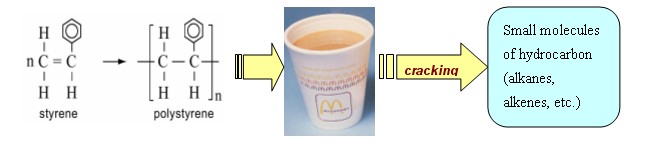
The method of cracking heavy oil fractions is applied to the decomposition or cracking of the polystyrene molecules into small molecules. We have tried out different ways of cracking in order to identify the best reaction conditions and the factors affecting the quality of the fuels produced have been investigated. We have also compared properties of different products.
Results
We found out that cracking polystyrene foam is relatively easy and we can obtain gaseous hydrocarbons, which can be used as gaseous fuels, as well as volatile liquid hydrocarbons, which can be used as liquid fuels. In addition, the gaseous hydrocarbons are a more favourable fuel, for it emits less smoke during burning.
Title
Generation of Electricity from Drainage
Abstract
We are at the verge of a global energy crisis. Therefore we decided to design an energy resource which is clean and can be widely used.
Each day, according to information from the drainage department of Hong Kong, an average of 800 litres of fresh water is used by a household with three members. As water flows down drainage pipes, which are on the sides of a building, a large amount of potential energy of the water is converted into kinetic energy. Water rushes down the drainage pipes rapidly.
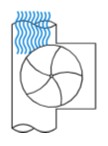
By using the large kinetic energy of water rushing down in drainage pipes on the sides of building close to the ground, we made a hydro-electrical power generator by adding a watermill-like turbine in a drainage pipe.
When water passes through the drainage pipe, it hits the watermill and makes the watermill spin. An axis and gears are attached to the watermill and spin with the watermill. The rotational force is brought to the dynamo and thus, electrical energy is generated. The electrical energy produced will then be stored in a battery. It can be used when needed. (eg.blackout in the building or for public services in the building (e.g. lighting). The experimental result shows that our device can generate 4.5 volts of electricity when water falls from 1st floor height.